
As federal administration continues to target public lands and California’s coast, California surges past halfway mark on world-leading conservation goals
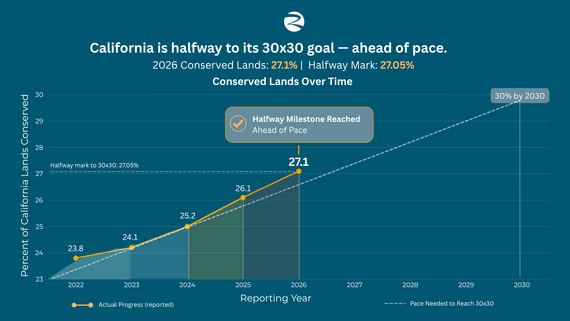
What you need to know: California has counted more than 3.5 million acres of conserved lands and coastal waters since 2022 - an area larger than Rhode Island and Delaware combined - putting the state more than halfway toward its goal to conserve 30% of lands and coastal waters by 2030.
SAN FRANCISCO - As the federal administration continues its assault on public lands, targets California's coast, and removes protections for wildlife, California is moving in the opposite direction – expanding stewardship and accelerating progress toward its goal of conserving 30% of lands and coastal waters by 2030 (30x30).
A new progress report released today shows California has surged past the halfway mark of the additional land conservation needed to reach 30x30 and is on track to meeting the land conservation goal by 2030. More than 1 million acres of land were added to the 30x30 database in the past year alone, bringing the state to 27.1% of lands conserved and 21.9% of coastal waters conserved. The Newsom administration and partners throughout the state celebrated the milestone at the annual 30x30 Partnership Summit in San Francisco today.
“While Donald Trump looks for ways to hand public lands to private developers and roll back the safeguards that protect our parks, wildlife, and coastal communities, California is doing the opposite. We are conserving more land than ever before, protecting our iconic coastline from new offshore oil and gas drilling, revitalizing wildlife habitat, and ensuring every Californian can experience the natural treasures that make the Golden State extraordinary.” - Governor Gavin Newsom.
Governor Newsom first launched California's 30x30 effort through executive order in 2020, making California one of the first governments in the world to commit to conserving 30% of its lands and coastal waters by the end of the decade. The Legislature later codified this commitment under SB 337, which the Governor signed into law in 2023.
“We've made tremendous progress, but this isn't simply about reaching a number on a chart,” said California Secretary for Natural Resources Wade Crowfoot. “We’re protecting the places Californians love and depend on - our rivers, forests, coast, and open spaces - and ensuring they remain healthy for generations to come."
California's progress has been powered by major state investments and partnerships with California Native American tribes, local communities, landowners, conservation organizations and others. Over the past four years, the Newsom administration and Legislature have invested nearly $1.3 billion in nature-based solutions. California voters also approved the $10 billion Climate Bond in 2024, which has already directed $5.8 billion toward biodiversity, parks, coastal resilience, water, wildfire resilience and other natural resource priorities.
Countering the federal assault on public lands
At the behest of special interests, the federal administration has launched a full-scale attack on programs that keep public lands protected and in public hands. This top-down approach from Washington politicians has created confusion and concerns from the local communities and businesses and recreational users who depend on and use these places. Additionally, many federal lands, such as the National Wildlife Refuge system have been left unmanaged and unsafe.
These attacks include but are not limited to:
- Numerous attempts to sell off public lands—most recently attempts to facilitate a give away Yosemite National Park lands to an out-of-state real estate developer.
- Illegal attempts to gut longstanding, predictable rules governing endangered species and public lands management like the Endangered Species Act and U.S. Forest Service Roadless Rule.
- Overriding states rights and federal-state partnerships by calling into question longstanding coastal management and state historic preservation programs, processes and funding.
- Disrespecting tribes by disregarding tribally-led federal land protections and diminishing or circumventing tribal consultation.
- Defunding and understaffing key federal agencies including the National Park Service, Bureau of Land Management, U.S. Fish and Wildlife Service, and U.S. Forest Service.
California's conservation push is delivering results
The acreage milestone is only one part of California's broader conservation effort.
This year, the Newsom Administration launched the state's first-ever Tribal Stewardship Policy and Tribal Stewardship Toolkit, establishing a statewide goal to expand tribal stewardship across at least 7.5 million acres of lands and coastal waters.
That builds on California's historic work to return ancestral lands to California Native American tribes. The first round of the Tribal Nature-Based Solutions Grant Program provided $107.7 million to support the return of approximately 47,000 acres to tribes, with additional funding now available through the Climate Bond.
California is also dramatically expanding access to the outdoors. Through State Parks Forward, Governor Newsom and California State Parks are working with conservation partners to create three new state parks in the Central Valley and expand existing state parks by 30,000 acres by 2030.
Other major milestones include:
California's 30x30 work is part of a broader push under Governor Newsom to protect natural resources while preparing communities for a hotter, more extreme climate. The Administration has expanded wildfire and forest resilience work, restored rivers and wetlands, invested in parks and outdoor access, advanced restoration at the Salton Sea and used nature-based solutions to reduce climate risks.
The new report also makes clear that protecting acreage is not the finish line. California is increasingly focused on ensuring conserved lands and waters remain healthy over the long term through restoration, stewardship, monitoring and sustained partnerships with tribes, conservation organizations and communities.
A statewide database powering 30x30
California’s ability to track conservation at a historic scale is driven by a single, statewide database that brings all verified conserved lands and coastal waters into one place. This unified system is a breakthrough for California: for the first time, the state can reliably measure and report conservation progress using consistent, transparent criteria. The state made a significant push this year to engage local partners on identifying previously uncounted conserved areas.
This comprehensive dataset underpins every milestone in the 30x30 effort. It ensures accuracy, strengthens public trust, and provides a shared foundation for partners across the state—from tribes and local communities to conservation organizations and landowners—who are helping deliver durable protections for the places Californians depend on.
How we got here
California established its 30x30 commitment in October 2020, when Governor Newsom signed an executive order calling for conservation of 30% of California's lands and coastal waters by 2030. The state released its Pathways to 30x30 strategy in 2022 following extensive public engagement.
Since then, California has turned that commitment into more than 3.5 million acres of additional conservation - and counting.
Read California's 2026 Pathways to 30x30 Progress Report.Legal Disclaimer:
EIN Presswire provides this news content "as is" without warranty of any kind. We do not accept any responsibility or liability for the accuracy, content, images, videos, licenses, completeness, legality, or reliability of the information contained in this article. If you have any complaints or copyright issues related to this article, kindly contact the author above.
